GST : 24ACOFS4771L2ZG
 Get A Quote

 Send Inquiry
SSC PTFE Coated Open Mesh Conveyor Belt
Price 2500.00 INR/ Piece
MOQ : 500 Pieces
SSC PTFE Coated Open Mesh Conveyor Belt Specification
- Features
- High temperature resistance up to 260C, excellent air permeability, non-stick surface, lightweight, easy installation
- Surface Finish
- PTFE coated, non-stick
- Thickness
- Available from 0.5 mm to 1.0 mm
- Belt Type
- Open mesh
- Material
- PTFE
- Type
- Open mesh conveyor belt
- Structure
- Flexible, mesh type
- Belt Conveyor
- Yes
- Color
- CREAM
- Resistant Feature
- Heat, chemical, corrosion and abrasion resistant
- Load Capacity
- Customizable as per requirement
- Speed
- Depends on conveyor configuration
- Usage & Applications
- Drying, curing, heat treatment, textile, food processing
- Tensile Strength
- High, suitable for demanding industrial environments
- Delivery
- Available in rolls or cut-to-length pieces
- Length & Width
- Custom-made as per application
- Operating Temperature Range
- -70C to +260C
- Joining Method
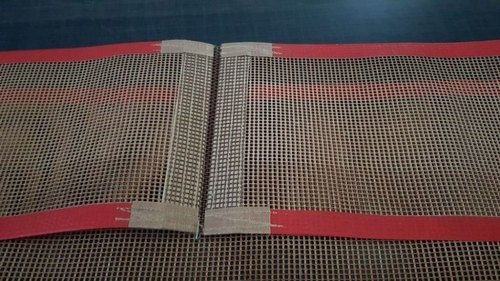
- Stainless steel clipper or customized joints
- Color
- Brown mesh with red edges
- Mesh Size
- 4x4 mm, 2x2 mm, or customizable
- Edge Reinforcement
- PTFE coated fabric edge with stitched finish
- Cleaning
- Easy to clean, minimal maintenance required
SSC PTFE Coated Open Mesh Conveyor Belt Trade Information
- Minimum Order Quantity
- 500 Pieces
- Payment Terms
- Cash Advance (CA), Cash in Advance (CID), Cheque
- Supply Ability
- 1 Piece Per Day
- Delivery Time
- 2 - 3 Days
- Sample Available
- Yes
- Sample Policy
- Within a certain price range free samples are available
- Packaging Details
- Box packing
- Main Export Market(s)
- Australia, North America, South America, Eastern Europe, Western Europe, Middle East, Africa, Central America, Asia
- Main Domestic Market
- All India
About SSC PTFE Coated Open Mesh Conveyor Belt
Our open mesh belts are used in screen printing to transport imprinted materials through drying ovens and cooling chambers. These belts are long lasting and perform well over a wide range of operating temperatures.
We offer below different types of belt Splice:
- Overlap splice: Belts end are cut straight or angularly at different angle overlapped to 25 mm to 100 mm and heat sealed. It gives a very strong joint. Strength of joint is more than the basic fabric strength. This joint makes the belt endless.
- Butt Splice: Both ends of the belts are cut straight or at different angles and butted together and the piece of PTFE/ Glass fabric of same or greater thickness is fused at the underside of the belt to get a smoother surface on top. Sometimes a piece of thin fabric is fused on the top side to protect the joint. This makes the belt endless.
- Two Ply Belt Splice: Two layer of PTFE/Glass cloth are laminated with staggered joint to achieve uniform thickness of the belt all over the belt length, to make a strong and endless belt.
- Smart Loop (Bullnose): A Leno woven fabric with braided thin Kevlar rope in fill direction which forms the loop, is used as a splice. This is stitched on both ends of leno woven mesh belt and a mono peak pin is used to complete the joint. This splice offers maximum airflow & flexibility at jointed portion. This makes the belt open ended.
- Metallic Alligator Splice: This is a strong metallic splice where metallic alligator is fixed on both ends of the belt & connected by a metallic pin to complete the joint. This makes the belt open ended. Open end belts are required where it is difficult to dismantle the machine & install the belt.
- Finger Splice: In this splice, small fingers are cut by a template at both ends of the belt and fixed in the alternative grooves and a piece of PTFE Coated Fiberglass Fabric is heat sealed on the top & bottom side of the joint to make it endless. It is an improvised butt joint which provides flexibility to run belt even at the smaller diameter of rollers of machine.
- Castellated Seal Splice (Fabric Pin Splice): Small dimension of fabric, heat sealed on both edges of the belt is cut alternatively to make hinges like fixing. A non- metallic pin is inserted to complete the joint. This belt is used where use of metal is undesirable.
- Edge Reinforcement: Both edges of the belt need protection from tearing while running and coming in contact with metallic components. Skived PTFE Film or PTFE coated Fiberglass cloth is fused on both edges or stitched by 100% PTFE Thread.
Belt Tracking System:
- Guide Button: Made of SS or Brass or PTFE studs are fixed on one side or both side of the belt at a fixed pitch and center distance width wise which run in the groove of the drive and driver roller to control the belt running straight on the machine. This is suitable for smaller width & shorter length belt.
- Braided Kevlar Profile: This is stitched at one edge of the belt which runs in the groove of the roller for keeping the belt in straight course.
Properties:
- Chemically Inert
- Non-Stick, Non-Toxic & Food Grade
- Un-affected by UV, IR & High Frequency
- High Tensile Strength with low elongation at break
Specification
| Surface Treatment | PTFE Coated |
| Material | PTFE |
| Tensile Strength | Upto 290 N/cm2 |
| Belt Width | 300 to 4200mm |
| Operating Temperature Range | -170 to +260 deg C |
| Brand | SSC |
| Usage/Application | Chemical Industry, Airspace Industry, Metallurgical Industry, Petroleum Industry etc |
High-Performance Design for Demanding Applications
Engineered to withstand extreme temperatures and industrial stress, this PTFE Coated Open Mesh Conveyor Belt excels in heavy-duty processes such as drying, curing, and heat treatment. Its superior tensile strength and flexible structure provide enhanced reliability even in the harshest settings.
Customizable for Your Unique Needs
Choose from mesh sizes of 2x2 mm, 4x4 mm, or request a custom specification to suit your specific application. Additionally, belt dimensions, joints, and load capacities are tailored to align with your operational requirements, ensuring seamless integration into existing conveyor systems.
Easy Maintenance and Long-Lasting Performance
The non-stick PTFE surface makes cleaning effortless-simply wipe or wash as needed. Minimal maintenance is required, and the material's resistance to heat, chemicals, and abrasion prolongs service life, reducing operational downtime and costs.
FAQ's of SSC PTFE Coated Open Mesh Conveyor Belt:
Q: How does the open mesh design benefit industrial processes?
A: The open mesh structure allows for superior air circulation and heat transfer, making it ideal for processes like drying, curing, and cooling in industries such as textiles and food processing. This design supports efficient product handling while maintaining high performance under demanding conditions.Q: What are the options for mesh size and how do I select the right one?
A: You can choose between 4x4 mm, 2x2 mm, or request a fully customized mesh size based on your application's airflow and product support needs. Smaller mesh provides finer support for delicate items, while larger mesh increases airflow for rapid drying or heat treatment.Q: When is edge reinforcement necessary for my conveyor belt?
A: Edge reinforcement with PTFE-coated fabric and stitched finish enhances belt durability, especially in high-load or high-speed operations. It prevents fraying, adds stability, and prolongs the service life of the belt in rigorous working environments.Q: Where can these conveyor belts be used?
A: SSC PTFE Coated Open Mesh Conveyor Belts are widely used in sectors like food processing, textile manufacturing, screen printing, drying ovens, packaging, and any application where heat resistance, airflow, and non-stick properties are essential.Q: What joining methods are available, and which should I choose?
A: Belts can be supplied with stainless steel clipper joints for quick installation or customized joints tailored to your system. The optimal joining method depends on your machinery type, cleaning requirements, and durability expectations-ask our technical team for advice.Q: How do I maintain and clean the PTFE coated conveyor belt?
A: The non-stick PTFE coating ensures that most substances do not adhere to the belt surface. Simply wipe clean or wash with water and mild detergent as necessary. Regular checks and periodic cleaning will maintain optimal performance with minimal effort.Q: What are the core benefits of using this conveyor belt in industrial applications?
A: Key advantages include high temperature and chemical resistance, customizable sizing, a flexible and lightweight structure, and easy installation. These factors lead to improved product quality, reduced operational interruptions, and lower total maintenance costs.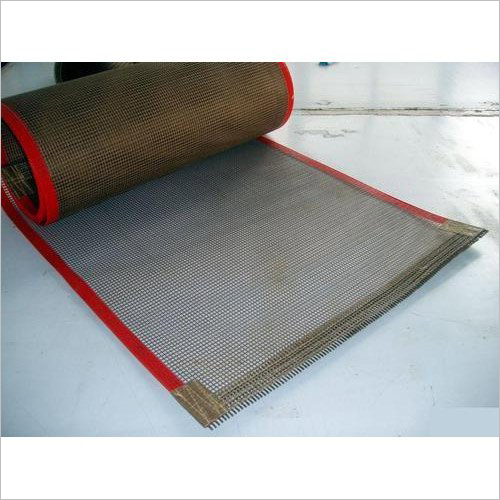
Tell us about your requirement

Price:
Quantity
Select Unit
- 50
- 100
- 200
- 250
- 500
- 1000+
Additional detail
Mobile number
Email

More Products in PTFE Coated Conveyor Belt Category

SSC PTFE Coated Mesh Conveyor Belt
Price 2500.00 INR / Piece
Minimum Order Quantity : 100 Pieces
Load Capacity : Customizable as per requirement
Thickness : Standard: 0.8 mm, Customizable
Material : PTFE
Structure : Other, Open Mesh, Flexible

SSC PTFE Coated Fusing Press Conveyor Belt
Minimum Order Quantity : 1 Piece
Load Capacity : Customizable as per application
Thickness : Available in various thicknesses, Standard: 0.25mm to 1mm
Material : PTFE
Structure : Other, Flat Belt with Metallic Eyelets

SSC PTFE Coated Conveyor Belt
Price 2500 INR / Piece
Minimum Order Quantity : 100 Pieces
Load Capacity : Customizable as per requirement
Thickness : 0.25 mm to 1 mm
Material : PTFE (Polytetrafluoroethylene) coated fiberglass
Structure : Other, Belt Conveyor

SHREE SHYAM CORPORATION
GST : 24ACOFS4771L2ZG
Contact Details

- 28, Parishram Industrial Hub, Sarkhej-Bavla Road, Chacharwadi-Vasana Road, Changodar,Ahmedabad - 382213, Gujarat, India

- Mr Kirit Solanki (Partner )
- Mobile :08045802262
- Phone :079-29798627

 Send Inquiry
 Send SMS

SHREE SHYAM CORPORATION
All Rights Reserved.(Terms of Use)
Developed and Managed by Infocom Network Private Limited.
Developed and Managed by Infocom Network Private Limited.


 English
 Spanish
 French
 German
 Italian
 Chinese (Simplified)
 Japanese
 Korean
 Arabic
 Portuguese
