GST : 24ACOFS4771L2ZG
 Get A Quote

 Send Inquiry
SSC PTFE Coated Mesh Conveyor Belt
Price 2500.00 INR/ Piece
MOQ : 100 Pieces
SSC PTFE Coated Mesh Conveyor Belt Specification
- Belt Type
- Mesh
- Thickness
- Standard: 0.8 mm, Customizable
- Surface Finish
- PTFE Coated
- Features
- High Temperature Resistance, Non-Stick Surface, Good Air Permeability, Durable
- Material
- PTFE
- Type
- Mesh Conveyor Belt
- Structure
- Open Mesh, Flexible
- Belt Conveyor
- Yes
- Roller Conveyor
- Optional
- Vertical Conveyor
- No
- Color
- CREAM
- Pneumatic Conveyor
- No
- Resistant Feature
- Heat Resistant, Chemical Resistant, Moisture Resistant
- Load Capacity
- Customizable as per requirement
- Speed
- Depends on system configuration
- Usage & Applications
- Food Processing, Textile Printing, Drying, Packaging
- Length
- Customizable as per conveyor system
- Mesh Size
- Common: 2 mm x 2 mm, other sizes available
- Operating Temperature Range
- -70C to +260C
- Width
- Customizable, Common: 1000 mm
- Edge Reinforcement
- PTFE Coated Kevlar or Fiberglass
- Color
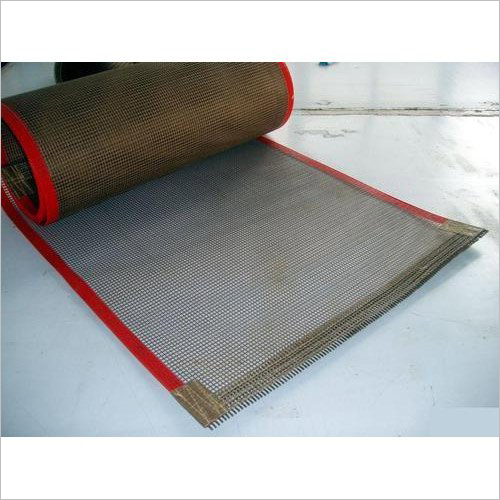
- Brown mesh with red edge reinforcement
- Custom Sizes Available
- Yes
- Packing Type
- Rolled, Export standard packing
- Maintenance
- Low; easy to clean surface
- Tensile Strength
- High tensile strength
- Manufacturing Method
- Woven fiberglass coated with PTFE
- Joint Type
- Bullnose, Alligator, or custom
SSC PTFE Coated Mesh Conveyor Belt Trade Information
- Minimum Order Quantity
- 100 Pieces
- Payment Terms
- Cheque, Cash in Advance (CID), Cash Advance (CA)
- Supply Ability
- 2 Pieces Per Day
- Delivery Time
- 3-4 Days
- Sample Available
- Yes
- Sample Policy
- Within a certain price range free samples are available
- Packaging Details
- Box packing
- Main Export Market(s)
- Australia, North America, Eastern Europe, Western Europe, Africa, Middle East, South America, Asia, Central America
- Main Domestic Market
- All India
About SSC PTFE Coated Mesh Conveyor Belt
Our open mesh belts are used in screen printing to transport imprinted materials through drying ovens and cooling chambers. These belts are long lasting and perform well over a wide range of operating temperatures.
We offer below different types of belt Splice:
- Overlap splice: Belts end are cut straight or angularly at different angle overlapped to 25 mm to 100 mm and heat sealed. It gives a very strong joint. Strength of joint is more than the basic fabric strength. This joint makes the belt endless.
- Butt Splice: Both ends of the belts are cut straight or at different angles and butted together and the piece of PTFE/ Glass fabric of same or greater thickness is fused at the underside of the belt to get a smoother surface on top. Sometimes a piece of thin fabric is fused on the top side to protect the joint. This makes the belt endless.
- Two Ply Belt Splice: Two layer of PTFE/Glass cloth are laminated with staggered joint to achieve uniform thickness of the belt all over the belt length, to make a strong and endless belt.
- Smart Loop (Bullnose): A Leno woven fabric with braided thin Kevlar rope in fill direction which forms the loop, is used as a splice. This is stitched on both ends of leno woven mesh belt and a mono peak pin is used to complete the joint. This splice offers maximum airflow & flexibility at jointed portion. This makes the belt open ended.
- Metallic Alligator Splice: This is a strong metallic splice where metallic alligator is fixed on both ends of the belt & connected by a metallic pin to complete the joint. This makes the belt open ended. Open end belts are required where it is difficult to dismantle the machine & install the belt.
- Finger Splice: In this splice, small fingers are cut by a template at both ends of the belt and fixed in the alternative grooves and a piece of PTFE Coated Fiberglass Fabric is heat sealed on the top & bottom side of the joint to make it endless. It is an improvised butt joint which provides flexibility to run belt even at the smaller diameter of rollers of machine.
- Castellated Seal Splice (Fabric Pin Splice): Small dimension of fabric, heat sealed on both edges of the belt is cut alternatively to make hinges like fixing. A non- metallic pin is inserted to complete the joint. This belt is used where use of metal is undesirable.
- Edge Reinforcement: Both edges of the belt need protection from tearing while running and coming in contact with metallic components. Skived PTFE Film or PTFE coated Fiberglass cloth is fused on both edges or stitched by 100% PTFE Thread.
Belt Tracking System:
- Guide Button: Made of SS or Brass or PTFE studs are fixed on one side or both side of the belt at a fixed pitch and center distance width wise which run in the groove of the drive and driver roller to control the belt running straight on the machine. This is suitable for smaller width & shorter length belt.
- Braided Kevlar Profile: This is stitched at one edge of the belt which runs in the groove of the roller for keeping the belt in straight course.
Properties:
- Chemically Inert
- Non-Stick, Non-Toxic & Food Grade
- Un-affected by UV, IR & High Frequency
- High Tensile Strength with low elongation at break
Specification
| Surface Treatment | PTFE Coated |
| Material | PTFE |
| Tensile Strength | Upto 290 N/cm2 |
| Belt Width | 300 to 4200mm |
| Operating Temperature Range | -170 to +260 deg C |
| Brand | SSC |
| Usage/Application | Chemical Industry, Airspace Industry, Metallurgical Industry, Petroleum Industry etc |
Customizable Dimensions and High Performance
SSC PTFE Coated Mesh Conveyor Belts can be manufactured in custom widths and lengths to fit your existing conveyor systems perfectly. With a common width of 1000 mm and a standard thickness of 0.8 mm, the belt is engineered for high tensile strength and optimal performance in demanding environments. The robust PTFE coated construction ensures stable operation even at extreme temperatures, making it suitable for diverse industries.
Exceptional Resistance and Easy Maintenance
Designed to withstand temperatures from -70C to +260C, these conveyor belts offer outstanding heat, chemical, and moisture resistance. Their durable non-stick PTFE coating makes regular cleaning hassle-free, supporting hygienic operations in food processing and other sensitive applications. Reinforced edges with Kevlar or fiberglass further extend the belt's lifespan and abrasion resistance.
Multiple Applications Across Industries
This mesh conveyor belt is widely used in food processing, textile printing, drying, and packaging, among other industries. Its good air permeability and open mesh structure enhance product throughput, while the customizable mesh size ensures suitability for various products and processes. As exporters, importers, manufacturers, and suppliers based in India, SSC provides reliable and flexible conveyor belt solutions globally.
FAQ's of SSC PTFE Coated Mesh Conveyor Belt:
Q: How is the SSC PTFE Coated Mesh Conveyor Belt customized for different conveyor systems?
A: The belt can be tailored in width, length, mesh size, joint type, and edge reinforcement to match your specific conveyor system needs. Simply provide your requirements, and SSC will manufacture the belt accordingly, including standard and non-standard sizes.Q: What are the main benefits of using a PTFE coated mesh conveyor belt in industrial processes?
A: Key advantages include high temperature resistance, non-stick surface for easy cleaning, excellent air permeability for efficient drying, chemical and moisture resistance, and enhanced durability due to strong woven fiberglass construction.Q: Where is this conveyor belt most commonly used?
A: The SSC PTFE Coated Mesh Conveyor Belt is widely used in food processing, textile printing, drying, and packaging industries, benefiting from its ability to withstand extreme conditions and facilitate continuous production.Q: What types of joints and edge reinforcements are available?
A: Joint options include bullnose, alligator, or fully custom joints, while edges can be reinforced with PTFE coated Kevlar or fiberglass, providing additional strength and preventing fraying during operation.Q: How should the belt be maintained for optimal performance?
A: Maintenance is straightforward thanks to the non-stick PTFE surface. Regular cleaning with mild agents will remove residues, and periodic checks of joints and edge reinforcements help ensure prolonged service life.Q: What is the process of manufacturing this conveyor belt?
A: The belt is produced by weaving fiberglass threads, which are then coated with high-quality PTFE. This provides superior tensile strength and guarantees an even, durable non-stick surface.

Tell us about your requirement

Price:
Quantity
Select Unit
- 50
- 100
- 200
- 250
- 500
- 1000+
Additional detail
Mobile number
Email

More Products in PTFE Coated Conveyor Belt Category

SSC PTFE Coated Fusing Press Conveyor Belt
Minimum Order Quantity : 1 Piece
Type : Other, PTFE Coated Fusing Press Conveyor Belt
Usage & Applications : Textile Fusing Machines, Heat Press Conveyors, Garment Manufacturing
Resistant Feature : Other, Heat Resistant, Chemical Resistant, Nonstick Surface
Load Capacity : Customizable as per application
SSC PTFE Coated Open Mesh Conveyor Belt
Price 2500.00 INR / Piece
Minimum Order Quantity : 500 Pieces
Type : Other, Open mesh conveyor belt
Usage & Applications : Drying, curing, heat treatment, textile, food processing
Resistant Feature : Other, Heat, chemical, corrosion and abrasion resistant
Load Capacity : Customizable as per requirement

SSC PTFE Coated Conveyor Belt
Price 2500 INR / Piece
Minimum Order Quantity : 100 Pieces
Type : Other, PTFE Coated Conveyor Belt
Usage & Applications : Textile curing, food processing, screen printing, packaging, heat sealing, shrink tunnels
Resistant Feature : Other, Heat and Chemical Resistant
Load Capacity : Customizable as per requirement

SHREE SHYAM CORPORATION
GST : 24ACOFS4771L2ZG
Contact Details

- 28, Parishram Industrial Hub, Sarkhej-Bavla Road, Chacharwadi-Vasana Road, Changodar,Ahmedabad - 382213, Gujarat, India

- Mr Kirit Solanki (Partner )
- Mobile :08045802262
- Phone :079-29798627

 Send Inquiry
 Send SMS
 Call Me Free

SHREE SHYAM CORPORATION
All Rights Reserved.(Terms of Use)
Developed and Managed by Infocom Network Private Limited.
Developed and Managed by Infocom Network Private Limited.


 English
 Spanish
 French
 German
 Italian
 Chinese (Simplified)
 Japanese
 Korean
 Arabic
 Portuguese
